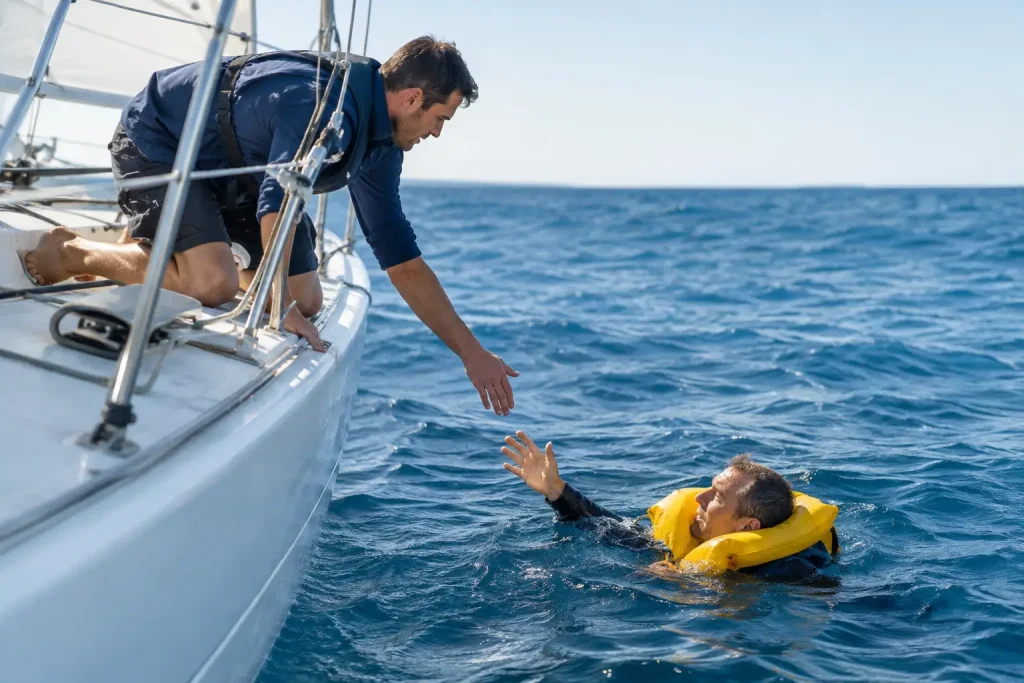
A person in the water can disappear behind a wave far faster than most new sailors expect. Knowing how to recover man overboard is not about executing a perfect textbook maneuver. It is about buying time, keeping sight of the person, protecting the crew from a second accident, and bringing someone back aboard with calm, deliberate teamwork.
On the BC coast, cold water turns a manageable problem into a serious one quickly. Practice the sequence before you need it, preferably under the eye of an experienced instructor, until every person aboard knows their first job.
The first minute: stop the emergency from growing
The moment anyone sees a person go overboard, they should shout, “Man overboard!” loudly and continuously until the whole crew responds. That clear call removes uncertainty. Everyone aboard needs to understand that normal sailing has stopped and the person in the water is now the sole priority.
One crew member should point continuously at the person in the water. Do not trade this job casually. The person pointing should keep their arm extended and their eyes on the casualty, calling out distance and direction as needed. On a moving boat, even a bright jacket can vanish in a few seconds, especially in chop, glare, rain, or low light.
At the same time, throw flotation toward the person. A life ring, horseshoe buoy, throwable cushion, or buoyant heaving line gives them something to hold and creates a visible marker. Throw it close enough to reach, but never directly at their head. If the boat carries a life sling or retrieval device, deploy it according to its instructions.
The skipper or a designated crew member should press the MOB button on the chartplotter or GPS. This marks the position, which can be invaluable if visual contact is lost. If conditions are serious, another capable crew member should make a distress call on VHF Channel 16 while the recovery is underway. Do not wait until every self-recovery attempt has failed if the person is injured, unconscious, poorly clothed for the water temperature, or drifting away rapidly.
How to recover a man overboard under sail
The right maneuver depends on your boat, wind strength, sea state, crew experience, and how quickly you can return to the casualty. There is no single turn that works perfectly in every circumstance. What matters is getting back under control without sailing away from the person or creating a dangerous approach.
For many cruising sailboats, a quick-stop maneuver is practical because it keeps the boat near the person. After the alarm is raised, tack immediately without releasing the jib. Allow the boat to round up and slow with the headsail backed. This can place the boat in a controlled position near the casualty while the crew prepares recovery gear.
A figure-eight approach is another useful method, particularly when there is room to maneuver and the crew has practiced it. Sail away on a close reach, tack, then return on a reciprocal course. As you near the person, reduce speed early. Your objective is not to demonstrate close-quarters sailing skill. It is to arrive slowly, predictably, and with the boat under command.
Approach from downwind or down-current when possible, so the boat drifts toward the person rather than over them. Keep the casualty on the leeward side of the boat, away from the boom and, if the engine is needed, away from the propeller. A sailboat can carry considerable momentum, so plan to stop well short and let the final drift bring the boat alongside.
If you start the engine, announce it clearly. Keep all lines, sheets, and recovery gear clear of the propeller. Once alongside, shift to neutral and stop the engine whenever conditions permit before bringing the person close to the stern. Propeller injuries are preventable, and they can turn a recoverable incident into a tragedy.
Assign jobs before the pressure arrives
A well-run recovery does not depend on one person doing everything. Even a small crew can divide the work into clear roles: one person steers, one keeps sight of the casualty, one handles communications and navigation, and one prepares the recovery equipment. On a short-handed boat, the skipper may have to combine roles, which is why early action and simple procedures matter so much.
Before leaving the dock, make sure everyone knows where to find life jackets, throwable flotation, the VHF radio, the first-aid kit, and the boarding ladder. Confirm that the ladder can be deployed from the water or by someone remaining aboard. A boarding ladder that is stowed too high to reach is of little use to an exhausted swimmer.
Practicing is not a substitute for prevention. Wear properly fitted life jackets, use tethers when conditions warrant, keep decks clear, move with one hand for the boat when offshore or in rough weather, and insist on a clear handhold when going forward. The best man-overboard recovery is the one you never have to perform.
Bring the person aboard without causing another injury
Getting alongside is only half the job. An adult who is cold, wet, frightened, or injured may not be able to climb a ladder unassisted. Avoid relying on raw strength. A tired crew can easily injure themselves trying to haul someone over the lifelines.
If the person is conscious and able to help, use the boarding ladder, a life sling, or a secure line around their torso to keep them connected while they climb. Keep the boat as stable as possible. Move deliberately, communicate clearly, and avoid having several people lean over one side at once.
For an unconscious or injured casualty, use a purpose-built recovery system, halyard, tackle, or lifting harness only if your crew has been trained to use it safely. Keep the person as horizontal as reasonably possible during lifting, particularly if they may be hypothermic. Sudden upright lifting can place extra strain on a severely chilled person’s circulation.
Never jump in after someone as an automatic response. This creates a second person in the water and removes a capable rescuer from the boat. Enter the water only in exceptional circumstances, with appropriate training, a tether, flotation, and a clear plan for getting both people back aboard.
Care for the casualty after recovery
Once aboard, move the person out of wind and spray. Remove wet clothing if you can do so without causing discomfort or unnecessary movement, dry them, and add warm layers or blankets. Offer warm, nonalcoholic fluids only if they are alert and able to swallow. Do not use direct, intense heat on a severely cold person, and do not massage cold limbs.
Check for injuries, breathing problems, confusion, or persistent shivering. A person may insist they are fine because adrenaline is high, yet their condition can worsen after the immediate rescue. Seek medical advice or emergency assistance when there is any concern. If the person was unconscious, submerged, injured, or significantly chilled, treat the situation as urgent.
Practice where mistakes are safe
A recovery drill with a fender is humbling in the best way. It reveals how quickly a target gets lost, how hard it is to stop a boat precisely, and why loose lines and unclear commands create trouble. Begin in moderate conditions with a well-marked flotation target, life jackets on everyone, and an experienced skipper aboard.
At Capt. Mac’s School of Seamanship, practical drills are treated as real seamanship, not a box to check. Repeating the alarm, approach, communication, and recovery sequence on a cruising sailboat builds the calm habits that matter when the water is cold and the stakes are real.
The next time you cast off, take two minutes to point out the flotation gear, ladder, radio, and MOB button to everyone aboard. That small conversation may be the most valuable part of the day’s sail.